Common Ground: The Commons (Community Board)
Hyperlocal community information discovered, curated, and governed fairly
Opportunity
Community information is scattered, broadcast-oriented, and governed by platforms that do not live in the community. The people who know what is happening locally have no native surface to share it.
Approach
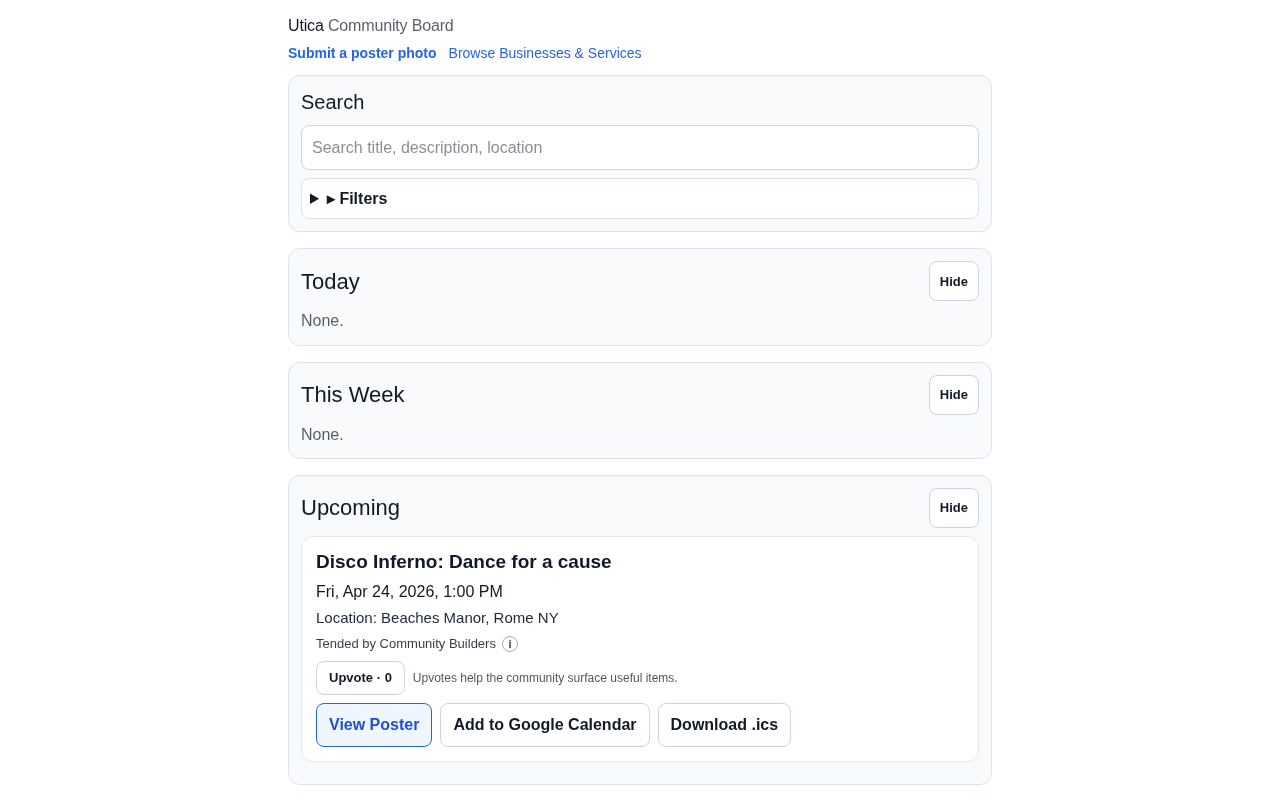
We built a photo-native community board where local information is discovered, not broadcast. The design grows from what happens when multiple people in a community each hold partial knowledge and need a shared surface to make the whole visible.
How we built it
Jobs to Be Done
- •
Resident: "Help me find out what is happening on my block this week."
- •
Contributor: "Give me a way to share what I know without broadcasting to the whole internet."
- •
Neighborhood organizer: "Show me what my community already knows so I can build on it, not duplicate it."
Sample from full framework
Desired Outcomes
- •
Increase visibility of hyperlocal information for residents within their immediate geography
- •
Reduce barriers to contributing community knowledge without requiring audience building
- •
Improve fairness of content moderation through structural governance rather than gatekeeping
Sample from full framework
Opportunity Solution Tree
- •
Top opportunity: community knowledge is fragmented across platforms that optimize for reach, not relevance
- •
Existing solutions fail: Facebook groups bury local posts in algorithmic feeds, Nextdoor treats neighborhoods as ad markets, bulletin boards do not scale
- •
Solution path: photo-native posts tied to geography, moderation through structure, discovery based on proximity
Sample from full framework
OOUX Object Mapping
- •
Post, Place, Contributor, Community, Moderation Event as core objects tied to geography and people
- •
Information is tied to a Place rather than a feed, so discovery is spatial rather than algorithmic
- •
Moderation Event is a first-class object with its own lifecycle, not a hidden admin action
Sample from full framework
Design Principles
- •
When reach and relevance conflict, choose relevance
- •
Information that matters to 50 neighbors is more valuable here than information that reaches 5,000 strangers
- •
Moderation scales through structure, not through requiring people to prove who they are
Sample from full framework
What comes next
Expanding community governance tools and building federation so multiple neighborhoods can run independent boards that connect when relevant.